
Blog
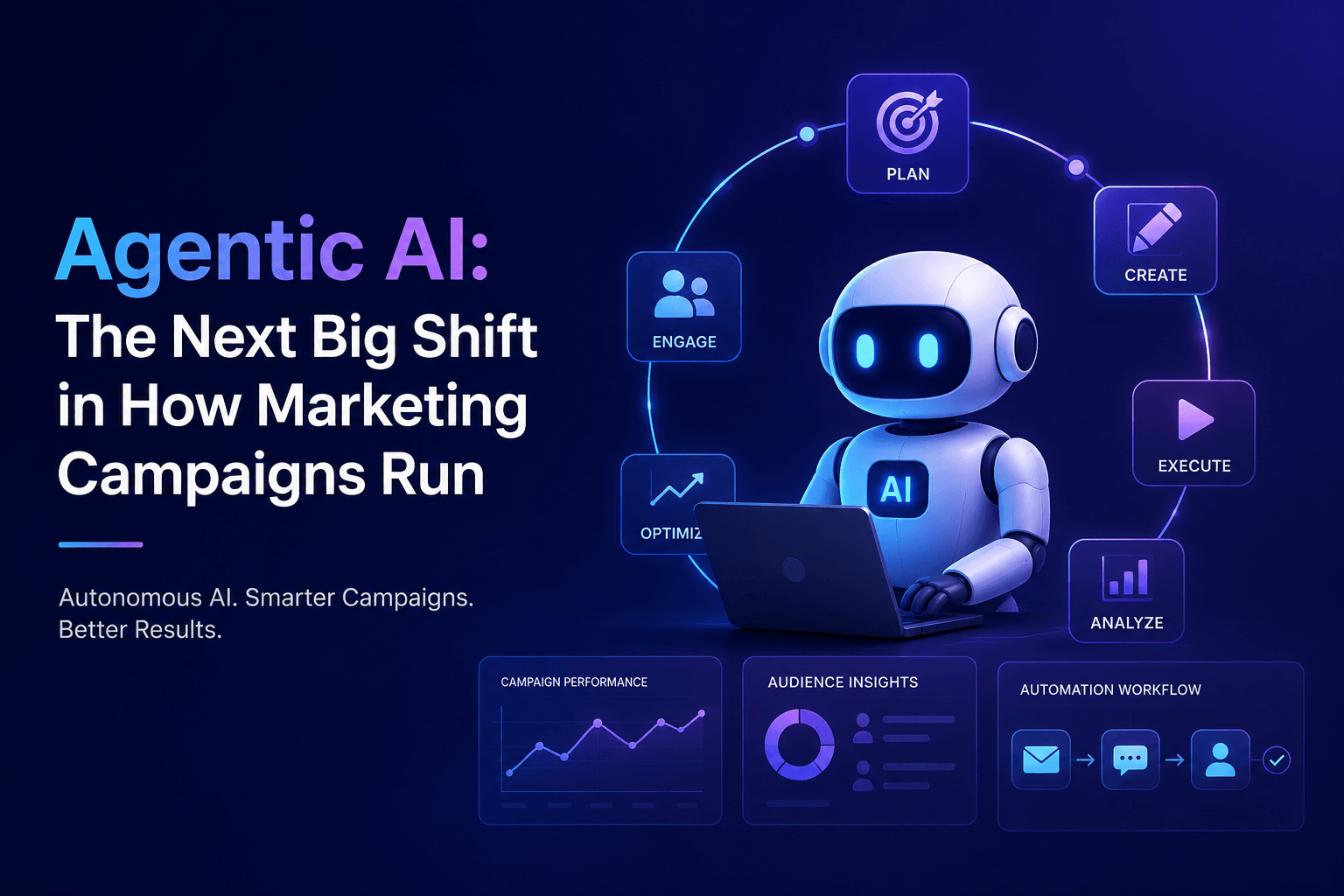
Agentic AI: The Next Big Shift in How Marketing Campaigns Run
Why Autonomous AI is Changing Marketing Forever Marketing has never been short of ideas. The real challenge has always been […]
Why Autonomous AI is Changing Marketing Forever
Marketing has never been short of ideas. The real challenge has always been execution.
Businesses today have access to countless channels—Google Ads, Meta, LinkedIn, WhatsApp, email marketing, SMS, SEO, content marketing, influencer collaborations, and more. While opportunities have increased, so has the complexity of managing them.
Most marketing teams aren’t struggling because they lack creativity. They’re struggling because they simply don’t have enough time or people.
Campaign planning, content approvals, audience segmentation, reporting, optimization, follow-ups, and customer nurturing often require multiple team members working across different platforms. Even small campaigns can involve dozens of repetitive tasks.
This is where Agentic AI is introducing a completely new way of working.
Unlike traditional AI that simply responds to prompts or creates content when asked, Agentic AI can independently plan, decide, execute, monitor, and improve multi-step marketing workflows with minimal human intervention.
Instead of acting like a tool, it behaves more like a highly capable digital team member.
For businesses operating with lean marketing teams, this represents one of the biggest technological shifts since marketing automation itself.
Understanding Agentic AI
Artificial Intelligence has evolved through several stages.
Initially, AI was designed to answer questions.
Later, it learned how to generate text, images, videos, and code.
Today, Agentic AI goes one step further.
Rather than waiting for instructions after every task, it can pursue an objective, make decisions during execution, adapt when conditions change, and complete complex workflows from beginning to end.
Think of the difference this way:
Traditional AI says,
“Tell me exactly what to do.”
Agentic AI asks,
“What’s the outcome you want? I’ll figure out the steps.”
That distinction changes everything.
Instead of prompting AI twenty different times, marketers define a business objective while the AI handles most of the operational work.
What Makes Agentic AI Different?
Most AI assistants remain reactive.
They generate social media captions.
They write blogs.
They suggest ad copy.
They summarize meetings.
Every new task requires another prompt.
Agentic AI introduces autonomy.
An autonomous AI system can:
- Understand business goals
- Break objectives into smaller tasks
- Prioritize actions
- Execute workflows
- Monitor performance
- Learn from results
- Recommend improvements
- Continue working until objectives are achieved
Rather than being a content generator, it becomes a workflow executor.
A Real Marketing Example
Imagine a company launching a new software product.
Traditionally, the marketing team might spend weeks coordinating activities.
Tasks include:
- Market research
- Competitor analysis
- Keyword planning
- Landing page creation
- Email campaigns
- Paid advertising
- Social media posts
- Creative approvals
- Analytics setup
- Daily optimization
- Weekly reporting
Each step requires communication between designers, copywriters, developers, advertisers, analysts, and management.
Now imagine Agentic AI.
The marketing manager simply defines:
“Launch Product X targeting manufacturing companies with a monthly budget of ₹3 lakh and generate qualified demo requests.”
The AI system could then:
- Research competitors
- Analyze customer pain points
- Build audience personas
- Recommend channels
- Draft campaign copy
- Create testing variations
- Schedule email sequences
- Launch ads
- Monitor conversions
- Pause poor-performing creatives
- Increase spend on better-performing campaigns
- Generate executive reports
- Suggest next optimizations
Human approval can still remain part of the process, but the operational workload decreases dramatically.
Why Marketing Teams Need This Shift
Marketing departments are under constant pressure.
Leadership expects:
- Faster launches
- Better ROI
- Lower costs
- More personalization
- More content
- Better reporting
At the same time, budgets rarely grow at the same pace.
Many organizations operate with lean teams where a handful of marketers manage responsibilities that previously required entire departments.
Industry surveys consistently show that more than half of marketers identify limited resources and bandwidth as one of their biggest barriers to effective campaign execution.
The issue isn’t strategy.
It’s operational capacity.
Agentic AI directly addresses this challenge.
Instead of asking teams to work longer hours, it reduces the amount of repetitive work requiring human attention.
From Automation to Autonomy
Marketing automation isn’t new.
Businesses have used automation for years.
Examples include:
- Welcome email sequences
- CRM workflows
- Scheduled social posts
- Lead scoring
- Automated reminders
However, automation depends on predefined rules.
If condition A happens…
Perform action B.
Agentic AI operates differently.
It continuously evaluates changing situations.
Instead of following fixed rules, it can reason through problems.
For example:
If a campaign suddenly experiences declining conversions, traditional automation continues executing scheduled activities.
Agentic AI may instead:
- Detect the decline
- Compare audience behavior
- Analyze competitors
- Recommend creative changes
- Reallocate advertising budget
- Notify the marketing manager
- Continue monitoring after implementation
This creates adaptive marketing rather than static automation.
How Agentic AI Supports Every Stage of a Campaign
Campaign Planning
Before any campaign launches, marketers spend significant time researching audiences and competitors.
Agentic AI can gather market intelligence, identify emerging trends, analyze competitors, and suggest campaign strategies much faster than manual research.
Audience Segmentation
Modern customers expect personalized communication.
Instead of broad audience categories, Agentic AI can identify behavioral patterns and dynamically refine audience segments based on real-time engagement.
Content Creation
Rather than producing one advertisement, Agentic AI can create multiple versions optimized for different customer groups, channels, and buying stages.
This allows continuous testing without overwhelming creative teams.
Campaign Launch
Launching campaigns often involves switching between multiple platforms.
Agentic AI can coordinate launches across several channels while maintaining consistency in messaging and timing.
Performance Monitoring
Campaign monitoring usually consumes hours every week.
Instead of manually checking dashboards, AI agents can identify anomalies, summarize insights, and recommend immediate corrective actions.
Continuous Optimization
Perhaps the greatest advantage is continuous learning.
Rather than waiting for weekly meetings, Agentic AI improves campaigns throughout their lifecycle.
Small adjustments made consistently often produce stronger long-term performance.
The Benefits for Small and Medium Businesses
Large enterprises can hire specialists for every marketing function.
Smaller businesses rarely have that luxury.
One person may handle:
- Social media
- SEO
- Paid ads
- Content
- Email marketing
- CRM
- Reporting
- Customer engagement
Agentic AI effectively expands the capacity of these teams.
Instead of replacing marketers, it removes repetitive operational work so they can focus on higher-value activities.
These include:
- Strategy
- Brand positioning
- Customer relationships
- Creative thinking
- Business growth
For startups and SMEs, this creates opportunities previously available only to much larger organizations.
Better Decision-Making Through Continuous Intelligence
Marketing generates enormous amounts of data.
Unfortunately, most businesses never fully utilize it.
Dashboards often provide information without context.
Agentic AI connects the dots.
Instead of reporting that conversions dropped, it may identify:
- The audience segment responsible
- The creative causing lower engagement
- Budget allocation issues
- Seasonal demand changes
- Competitor activity
- Landing page performance
It doesn’t simply present numbers.
It provides recommendations.
This shortens decision cycles considerably.
Human Creativity Still Matters
One common misconception is that autonomous AI replaces marketers.
In reality, the opposite is more likely.
Marketing is fundamentally about understanding people.
Brand identity.
Storytelling.
Trust.
Emotional connection.
Customer relationships.
These remain deeply human strengths.
Agentic AI excels at execution, coordination, analysis, and optimization.
Humans continue providing:
- Vision
- Ethics
- Creativity
- Strategic judgment
- Customer empathy
The strongest marketing organizations will combine both.
Challenges Businesses Should Consider
Like every emerging technology, Agentic AI requires thoughtful implementation.
Businesses should consider:
Data Quality
Poor-quality customer data leads to poor decisions.
Reliable data remains essential.
Governance
Organizations must establish approval processes for high-impact decisions such as pricing, public messaging, or legal communications.
Security
AI systems often access multiple platforms.
Proper permissions and cybersecurity practices become increasingly important.
Human Oversight
Autonomy should not eliminate accountability.
Marketing leaders should review strategic decisions while allowing AI to handle operational execution.
Preparing Your Business for Agentic AI
Businesses don’t need to transform overnight.
A practical approach is gradual adoption.
Start by identifying repetitive marketing tasks.
Examples include:
- Weekly reporting
- Lead qualification
- Content scheduling
- Campaign monitoring
- Performance summaries
- Customer follow-ups
Once teams become comfortable working alongside AI, additional responsibilities can gradually be delegated.
Successful organizations will likely adopt a “human-in-the-loop” model where AI executes efficiently while humans supervise critical decisions.
The Future of Campaign Management
Marketing has evolved through several major shifts.
From print to digital.
From desktop to mobile.
From manual advertising to automation.
Agentic AI represents the next major evolution.
Campaigns will increasingly become living systems capable of monitoring themselves, adapting continuously, identifying opportunities, and improving performance without requiring constant manual intervention.
Businesses that embrace this technology early are likely to gain significant advantages in speed, efficiency, and scalability.
Those that ignore it may find themselves struggling to compete against organizations capable of executing marketing campaigns faster, more intelligently, and at a fraction of today’s operational effort.
The future of marketing isn’t simply about creating more content or running more advertisements. It’s about building intelligent systems that can turn strategy into execution with remarkable speed and precision.
Agentic AI is not just another AI trend. It represents a fundamental shift in how modern marketing campaigns are planned, executed, optimized, and scaled. For businesses facing limited marketing bandwidth, increasing competition, and growing customer expectations, autonomous AI offers a practical path toward doing more with the resources they already have.
As the technology continues to mature, the question will no longer be whether businesses should use Agentic AI, but how quickly they can integrate it into their marketing operations while maintaining the human creativity and strategic oversight that define exceptional brands.
Frequently Asked Questions (FAQs)
1. What is Agentic AI?
Agentic AI refers to autonomous AI systems that can independently plan, execute, monitor, and optimize multi-step tasks to achieve a defined goal with minimal human intervention.
2. How is Agentic AI different from traditional AI?
Traditional AI mainly responds to prompts or performs single tasks. Agentic AI can make decisions, coordinate multiple activities, adapt to changing conditions, and complete entire workflows autonomously.
3. Can Agentic AI replace marketing teams?
No. Agentic AI is designed to augment marketing teams by automating repetitive and operational work. Human marketers remain essential for strategy, creativity, branding, and customer relationships.
4. Which businesses benefit the most from Agentic AI?
Small and medium-sized businesses, startups, and lean marketing teams often gain the greatest advantages because Agentic AI helps them accomplish more without significantly increasing headcount.
5. Is Agentic AI suitable for digital advertising?
Yes. It can assist with audience research, campaign setup, budget allocation, creative testing, performance monitoring, and optimization across multiple advertising platforms.
6. Does Agentic AI require technical expertise?
Modern Agentic AI platforms are becoming increasingly user-friendly. While technical knowledge can help, many solutions are designed for marketers and business users rather than developers.
7. What are the biggest advantages of Agentic AI?
Some of the key benefits include faster campaign execution, reduced manual workload, continuous optimization, better decision-making, improved scalability, and enhanced marketing efficiency.
8. Are there any risks associated with Agentic AI?
Yes. Businesses should pay attention to data quality, governance, cybersecurity, privacy, and human oversight to ensure AI systems operate responsibly and align with business objectives.
9. Can Agentic AI work alongside existing marketing tools?
Yes. Many Agentic AI solutions are designed to integrate with CRMs, advertising platforms, analytics tools, email marketing software, and customer engagement platforms, allowing businesses to enhance their existing workflows.
10. Is Agentic AI the future of marketing?
Agentic AI is widely viewed as a major step forward in marketing operations. While human expertise will remain indispensable, autonomous AI is expected to play an increasingly important role in campaign management, optimization, and business growth.