
Social Media Marketing
Social Media in 2026: What’s Working and What’s Dead
Social media has gone through multiple evolutions over the past decade—but 2026 marks one of its most defining shifts yet. […]
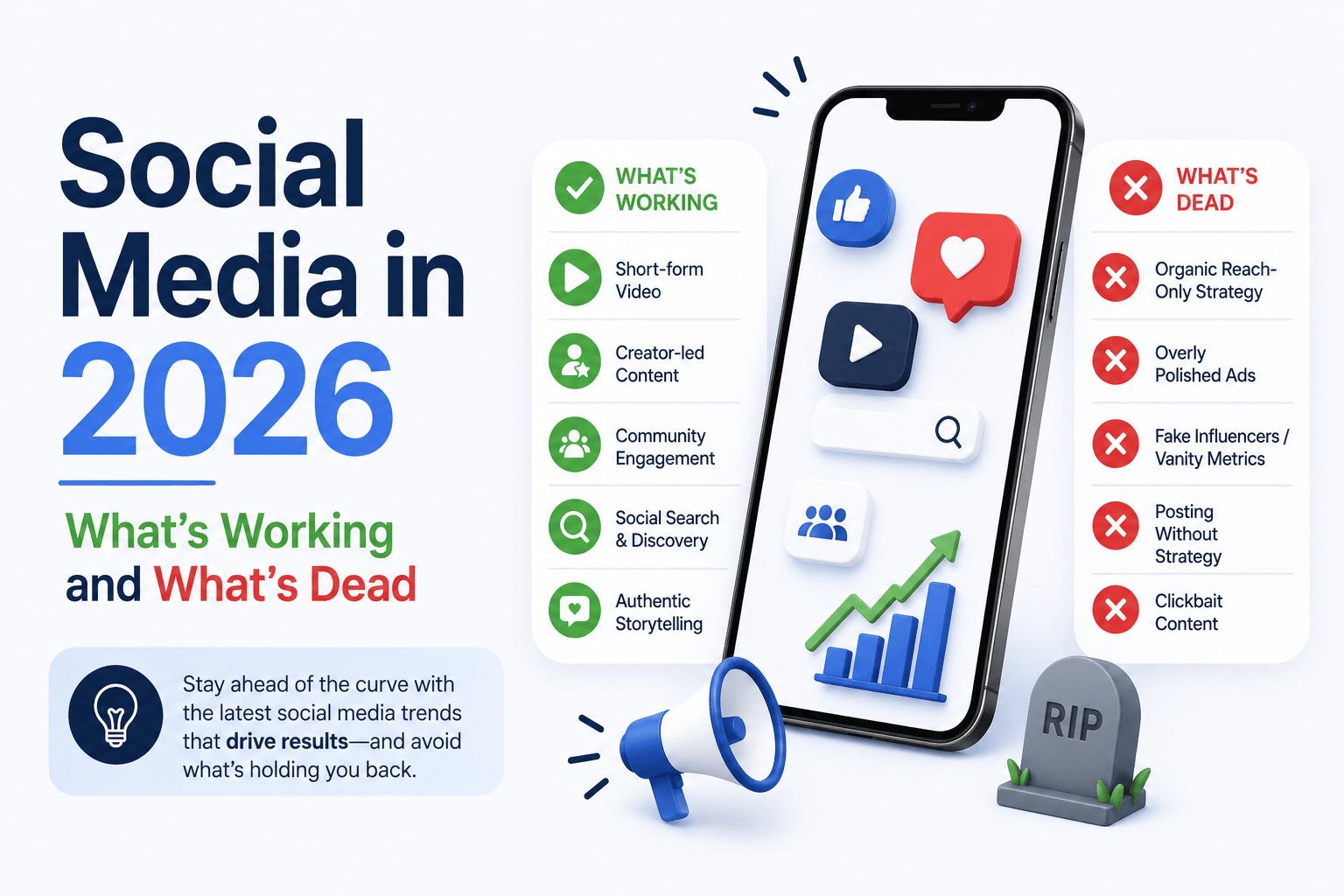
Social media has gone through multiple evolutions over the past decade—but 2026 marks one of its most defining shifts yet. What was once a space dominated by visibility and virality has now matured into a performance-driven ecosystem where trust, relevance, and conversion determine success.
Many brands are still operating with outdated playbooks—chasing trends, obsessing over follower counts, and producing content that looks good but delivers little value. The result? High effort, low impact.
If you want to stay relevant in 2026, it’s not about doing more—it’s about doing what actually works.
This blog breaks down the real shift: what’s driving results today and what strategies are no longer worth your time.
The New Reality of Social Media
Before diving into tactics, it’s important to understand the bigger picture.
Social media platforms are no longer just distribution channels. They are decision-making ecosystems. Whether it’s choosing a service provider, evaluating a brand, or forming an opinion—users rely heavily on what they see online.
Three major changes define this new reality:
- Attention spans are shorter, but expectations are higher
- Audiences are more informed and skeptical
- Algorithms prioritize engagement depth over reach volume
This means surface-level content doesn’t survive anymore. You either deliver value—or you disappear.
What’s Working in 2026
1. Value-Driven Short-Form Content
Short-form video continues to dominate, but the nature of content has changed significantly. Earlier, trends and viral formats could drive reach. Today, value is the differentiator.
Content that performs well:
- Quick insights that solve a specific problem
- Bite-sized educational content
- Relatable storytelling with a takeaway
The first few seconds are still critical, but what follows matters even more. If your content doesn’t deliver something meaningful, users will scroll past regardless of how catchy the opening is.
The key shift:
From entertainment-first to value-first content.
2. Human-Led Branding
In 2026, audiences don’t connect with brands—they connect with people behind them.
This is why founder-led content, employee advocacy, and personal storytelling have become essential. When a real person shares insights, experiences, and opinions, it builds a level of trust that no polished brand campaign can match.
What works:
- Founders sharing lessons, failures, and perspectives
- Leadership voices commenting on industry trends
- Teams showcasing culture and behind-the-scenes moments
This doesn’t mean brands disappear—it means brands become more human.
3. Authority Through Education
Social media is no longer just a marketing tool—it’s a knowledge platform.
Users are actively seeking content that helps them learn, improve, or make better decisions. Brands that position themselves as educators are naturally seen as authorities.
High-performing formats include:
- Step-by-step guides
- Industry breakdowns
- Myth-busting posts
- Case studies with real numbers
Instead of saying “we are experts,” brands now prove expertise through consistent, insightful content.
4. Niche Positioning and Clarity
Trying to appeal to everyone is one of the fastest ways to become irrelevant.
In 2026, the most successful social media strategies are built around clear positioning. Brands that define their audience, messaging, and value proposition sharply are outperforming those with broad, generic content.
What this looks like:
- Content tailored to a specific industry or audience segment
- Clear communication of problems solved
- Consistency in tone and messaging
Niche doesn’t mean small—it means focused.
5. Community Building Over Broadcasting
The days of one-way communication are over. Social media is now about interaction, not just distribution.
Brands that treat their audience as a community—not just viewers—are seeing stronger engagement and loyalty.
What works:
- Responding to comments and messages actively
- Asking questions and encouraging conversations
- Creating content based on audience feedback
Community-driven brands benefit from higher retention, stronger trust, and organic growth through word-of-mouth.
6. Content Ecosystems, Not One-Off Posts
Single posts rarely drive meaningful results anymore. Successful brands think in terms of content ecosystems.
Instead of creating isolated pieces of content, they build interconnected narratives:
- A video leads to a carousel
- A carousel leads to a deeper blog
- A blog leads to a newsletter or consultation
This approach increases content lifespan and improves conversion opportunities.
7. Strategic Use of AI
Artificial intelligence has become a powerful tool in content creation—but it’s not a replacement for human thinking.
In 2026, the winning approach is AI-assisted, human-refined content.
AI helps with:
- Idea generation
- Drafting and structuring
- Content repurposing
Humans bring:
- Perspective
- Context
- Original insights
Audiences can easily detect generic, AI-heavy content. The brands that stand out are the ones that combine efficiency with authenticity.
8. Performance-Focused Metrics
Metrics have evolved. Vanity numbers like likes and follower counts are no longer the primary indicators of success.
What matters now:
- Leads generated
- Conversion rates
- Engagement quality (comments, saves, shares)
- Customer acquisition cost
Brands are shifting from “how many people saw this?” to “how many people acted on this?”
What’s Dead in 2026
1. Blind Consistency Without Strategy
The old advice of “post daily to grow” has lost relevance.
Posting frequently without a clear purpose leads to content fatigue—for both creators and audiences. Platforms now prioritize meaningful engagement over sheer volume.
The shift:
From quantity-driven to quality-driven content.
2. Overly Polished Corporate Messaging
Perfectly designed posts with generic captions no longer resonate.
Audiences prefer:
- Real conversations over formal announcements
- Honest opinions over safe messaging
- Authentic voices over brand jargon
Content that feels scripted or overly curated often gets ignored.
3. Trend Chasing Without Context
Jumping on every trend might give temporary visibility, but it rarely builds long-term value.
Irrelevant trends dilute brand identity and confuse audiences.
In 2026, relevance is more important than reach.
If a trend doesn’t align with your brand, it’s better to skip it.
4. Platform Dependency
Relying heavily on a single platform is risky.
Algorithm changes, policy updates, or platform decline can significantly impact reach overnight. Smart brands are diversifying their presence and building owned channels like email lists and communities.
5. Generic Content
Content that tries to appeal to everyone ends up appealing to no one.
Generic advice, repeated ideas, and surface-level insights are easily ignored in a saturated content environment.
Uniqueness now comes from:
- Personal experiences
- Specific examples
- Clear opinions
6. Ignoring Conversion Strategy
Many brands still focus on engagement without a clear path to conversion.
In 2026, content is expected to guide users through a journey:
Awareness → Interest → Trust → Action
Without this structure, even high engagement doesn’t translate into business results.
The Strategic Shift: From Content Creation to Content Thinking
The biggest change in 2026 is not in formats or platforms—it’s in mindset.
Successful brands are no longer just creating content. They are thinking strategically about content.
This includes:
- Understanding audience behavior deeply
- Aligning content with business goals
- Measuring impact beyond surface metrics
- Continuously refining strategy based on data
Content is no longer an isolated function—it’s integrated into overall business growth.
Common Mistakes Brands Must Avoid
Even with the right knowledge, execution often goes wrong. Here are key mistakes to watch out for:
- Creating content without understanding the audience
- Prioritizing aesthetics over substance
- Ignoring feedback and engagement signals
- Expecting immediate results without consistency
- Treating all platforms the same
Avoiding these mistakes can significantly improve outcomes.
What the Future Looks Like
Looking ahead, social media will continue evolving—but a few principles will remain constant:
- Authenticity will outperform perfection
- Value will outperform volume
- Trust will outperform visibility
New tools, formats, and platforms will emerge, but the core objective will stay the same:
building meaningful connections that drive real outcomes.
Final Thoughts
Social media in 2026 is more competitive—but also more rewarding for those who approach it strategically.
The opportunity is not in doing everything—it’s in doing the right things consistently.
If your content informs, engages, and builds trust, growth becomes a natural outcome—not a forced effort.
If you’re looking to implement a high-impact, results-driven social media strategy—partnering with the right team can make all the difference.
MidhaBackers stands out as a strategic consulting and growth-focused firm that understands the evolving dynamics of digital platforms. With a strong focus on business outcomes rather than vanity metrics, they help brands:
- Build authority through content
- Develop conversion-oriented strategies
- Align social media efforts with broader business goals
- Unlock growth through structured, data-backed approaches
In a landscape where execution matters as much as strategy, working with a team like MidhaBackers can help you stay ahead of the curve and turn social media into a real business asset.
Bottom Line:
Social media success in 2026 is not about chasing algorithms—it’s about understanding people.
And brands that get this right will not just grow—they’ll lead.